Good for organisation is good for all

Any organisation or corporate entity has several stakeholders attached to it. Here for the sake of simplicity, we shall stick to a banking entity, part of the industry that I have remained associated with for decades.

The first stakeholder is the promoter; while for PSBs, Government is the main shareholder and promoter in that sense, this stakeholder is more relevant for the likes of Indusind and Kotak, where an individual and a family clearly enjoy this position. ICICI, HDFC and Axis have always been institutionally promoted and currently widely held mainly by FIIs.

The second stakeholder are shareholders; for listed entities, retail investors are more vociferous and employees through ESOP routes also assume the status of being a shareholder. Institutional shareholders are more strategic and have a bit longer term perspective.

The next important stakeholder are the employees led by the CEO. While the top management provides vision and leadership, the middle and lower management actually manage day to day affairs. The top leadership is a major beneficiary of high salaries, perquisites, bonuses and ESOPs that’s justified given their larger responsibility in achieving corporate goal and vision.

The last stakeholder in this chain are the customers who provide the fodder to the bank by trusting it with their deposits and borrowing funds to start/expand their business.

In the sense of value or importance, the last stakeholder viz. Customer, assumes the most important position as the company survives to see another day till it has customers and their transactions to handle! Therefore, it’s important for any promoter, shareholder or management to do what’s ultimately right for the customer. And I am not talking anything new. When I joined banking industry four decades ago, the importance of customer and his satisfaction was never understated! And what started as customer service, gradually evolved into customer satisfaction and further into custom centricity. Now, some organisations are taking this into a different level calling it customer obsession.

And mind you, my above view is nothing new arising out of my current status, which is merely that of a customer of a bank. Customers trust banks with their life’s earning and it’s paramount upon all the stakeholders to keep customers’ interest uppermost. Everything else – promoter’s investment returns, shareholders’ value appreciation, employees’ remuneration should come after customers not necessarily in this pecking order.

The provocation for this post is the Q4 results announced by my erstwhile organisation that has reported losses due to upfront booking of total cost of acquiring Citi’s retail business as a good conservative policy. Obviously, this has earned the wrath of some retail investors who feel that this has been done to deprive them of higher dividends and also adversely affected their chances of exiting at a higher market price. My take if that if it’s a conservative measure aimed at the eventual good of the organisation ( and hence its customer) , let’s take it as an ultimately a good step rather than what could be a temporary aberration for other stakeholders. If something makes an organisation stronger, it’s for ultimate good of all concerned.
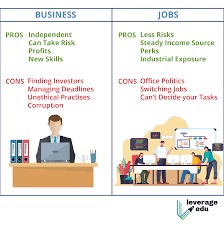
Jobs, business or startup ?

I think pressure at workplace is not quite a recent phenomenon but has all along been there. Recently came across an article in a popular periodical that regularly publishes articles from its previous editions that could be decades old. This article republished after two decades has a beautiful line that reads, “ Nagging boss, crabby clients, looming deadlines…. if unemployment didn’t pay so badly, you’d choose it as a career.” To this, if I may add the following two lines of my own – (1) If only starting a new business wouldn’t be so risky and expensive, I’d be rather my own boss and (2) It’s so disheartening that startups have a failure rate of 90% and I may not be lucky or brilliant enough to not to be burning my fingers there! And the above three scenarios loosely sum up the challenge before today’s youth. Jobs are highlighted by pressures from bosses, clients, targets and deadlines. A new business in one of the traditional industries can entail huge investments and competition from the established players. A start up converting a brilliant idea into a commercial proposition is prone to exceptionally high failure rates.

I am of the opinion  that all the above scenarios need to change. Jobs have to offer a more pleasant and lasting experience, existing players in the established industry have to be more open to new competition that helps them improve their own  efficiency and quality  and we probably need more of, now defunct, Silicon Valley Bank that understand the risks associated with startups promoting new technologies. 

Sent from my iPhone

I bow to you

Till the other day, nobody had heard the name of Dr C R Rao. Today, this centenarian is a household name and an inspiration for several new senior citizens like the author of this blog, who hitherto treated their retirement from job as end of the road! US Government’s decision to bestow upon this statistician/mathematician an award that’s considered at par with Nobel prize for his contribution to mathematics at his ripe age of 102 years, reads like a story straight out of the pages of a racy fiction thriller.

After superannuating from his job, Mr Rao decided to emigrate to US, acquired citizenship at the age of 75 years and is now felicitated by US Government for his contribution to mathematics.

Many of us, with children abroad, tend to think of relocating ourselves as loneliness sometimes can be excruciating. However, the objective of migrating to the country where our children are working is to continue with sedate life that’s being led in India and help our children with household jobs and babysitting our grandchildren. Seldom one does and achieve what Mr Rao has accomplished!

At least, I, who almost one year into retirement was almost reconciled to living a life of idleness and rest, feel immensely inspired by Mr Rao’s fairy tale achievement and am ready to wear my boots that I thought I had hung for good!

Mr Rao’s feat is a testimony to the fact that it’s never too late to pursue a dream or an objective and the life needs to be lived to the fullest by generously interspersing passions, hobbies, interests with active participation in societal and community development activities. This could also be a key to living a longer, healthier and more satisfying life.

Thank you Mr Rao for inspiring millions of new senior citizens like me, reconciled to living a life that’s sedentary, staid, unexciting and basking in the past glory and achievements. You have shown the way and it’s up to us now to walk this path. May you live longer and healthier and continue to inspire a whole generation of those who think life is just to be dragged along after a certain age!

Attrition- Employees leaving in distress

In the last article on attrition, in which I covered the other perspective viz. employee driven attrition, there was a suggestion that I also touched the aspect of the employees leaving in distress.

The reason for an employee getting distressed are as wide and varied as individual personalities! Some of us are hypersensitive and can take the extreme step of quitting the job at the slightest provocation caused by the boss’s displeasure at some act of ours! And mind you, it may not necessarily be humiliating firing by the boss, but just a subtle expression of displeasure! But on the contrary, extremely impersonal and curt attitude by the boss that leads to vitiation of office atmosphere, remains the single most important reason causing distress to employees and their ultimate attrition. And this I am writing from my personal experience! Many employees in my department sought to change jobs because of humiliation and suffocation caused by their immediate bosses, the team leaders! I used to tell such employees that this did not warrant such an extreme step, because bosses came and went and were not permanent. To the bosses, I used to advise them to be more patient, approachable and humane ( of course not telling them to emulate me as every boss considers himself/ herself to be unflawed). But we generally tend to blame organisations and their policies for high attrition rates, whereas the fact is that even in highly demanding professional organisations, good natured bosses can soothe the nerves by absorbing some of the top management pressure at his/her level. Many diktats from the top are for the consumption for senior managers not to be passed ad verbatim to the junior team members, who are already slogging hard on day to day basis.

PMS and year end appraisal are the next big causes of distress. After working hard for the entire year, employees expect, and rightfully so, good rating as all the year end benefits and promotions are a function of year end assessment and rating of the employee. While it’s true that performance based differentiation is a must for any organisation to encourage high performing employees, the fact is that several not at all bad employees fall victim to the forced bell curving that organisations indulge in to comply with certain prefixed metrics. We generally observe high distress, disappointment and attrition in the period immediately after year end assessment

Transfer to an undesired place or department, reduction in the scope of work or realm of responsibility, denial of leave or some other privilege and pressure of business targets and the ways and means of follow up thereof by the supervisors are a few of other reasons causing distress.

It’s important that employees overcome the instances of personal distress by learning and adopting stress management techniques and adapting to the prevalent conditions. Disappointments relating to rating, increment, bonus, promotion, boss’s behaviour should be taken as temporary aberration rather than as end of all. They should quit only for a better job.

April Fool’s Day – a fresh perspective

I wish I was still working and had a great year end closing day,

But it was not so, as it turned out to be April Fool’s day;

The world was not divided but one family having a fun filled peaceful day,

Instead, I got a rude shock to know it was just April Fool’s Day;

And that our earth was replete with food, shelter and water for all each day,

But I was fooled on the April Fool’s day;

And there’s no ethnic, casteist, religious divide as humanity spent together a day,

Unfortunately, I woke up to reality to realise it was an April Fool’s Day;

And as I got deeply mired in pessimism and negativity on this day,

I realised- Reality is not so stark as it was only an April Fool’s Day!

This April Fool’s Day, let’s befool sectarianism, casteism, ethic/religious divide, terrorism, separatism, hunger, treachery and other such vices and celebrate this day in altogether a new spirit that spreads happiness!

Happy financial year ending

As I confided into an old friend and a colleague of mine that it was after ages that I was so relaxed on the last working day of the year for a Bank. Why ages? In fact, for the first time after I turned a professional banker in 1985 that 31st March is just like any other day and I can really say to myself that “ Thanks God it’s Friday”.

I recall that how the last working day used to be an extremely stressful and busy day. Whether it was a branch role, a business role or an ops role, the last day always held an unmatched importance. It was as if we were all sleeping till yesterday and that there was no next day! Every transaction worth its salt needed to be consummated before the last day ended! And here I am not making any mention of the internal, non- customer maintenance jobs that was an altogether a different story!

It was often discussed that bundling of transactions on the last day should be avoided, but it never happened and it was understandably so! I never complained then and now that there’s no ground for me to complain, I feel even happier!

Like many other events in life, the changed priorities have rendered quite a few of these redundant. Year end closing, PMS, promotion, increment, bonus are all the things that were so important till the other day, are today only confined to my memories!

V K Sehgal – As only he can be

V K Sehgal ( VKS), Vijay Mana to me, is not merely my mother’s younger brother and a Mama by that relation to me. In fact, his status in my life is quite exalted- in a sense higher than that of God! Because, apart from being a Mama, he has been a Guru, a pathfinder for me and our scriptures rate a Guru higher than God.

And what a life he has lived! A brilliant student, he put his knowledge to good use by joining academics and was a senior chemistry teacher for quite a few years. In this role, he not only guided and inspired children in the family, but students community in general and students taught by him achieved academic and professional excellence. But such was his aura and influence on their impressionistic minds ( including mine) that after more than 5 decades, a few of his students holding eminent positions in their respective yuve fields today, have same regard and respect for their onetime school teacher!

But he was destined for bigger things. Much later into his married life and after attaining fatherhood, he cracked much sought after but feared civil services examination to join Indian revenue services. After decades of excellence in his career, he today leads a relaxed, but not reclusive by any standards, life with his children and grandchildren.

What makes him unique? His intelligence, sharpness, wit and such faculties of mind are all laced with human kindness, empathy and helpfulness, making him to be a person with golden heart! The entire extended family, including people like me, living more than a thousand kilometers away from him, feel secured that if any of us in trouble, our Vijay Mana is there for us! And for me, it’s been all the more relevant, because he treated my parents ( his much elder sister and brother in law that’s my further) like a son, being there for them through thick and thin!

On 1st of April this year, our Vijay Mama turns 75, a diamond man with a heart of gold turning platinum. His loving sons, Amit and Nitin along with their spouses Rupali and Vandana, have decided to celebrate the life so far of this great man with the grandeur it deserves by hosting a gala bash! I am unable to join the celebrations due to some prior commitments, but my heart will be there and mind focused on almighty, praying for this man’s long and healthy life, because not only this extended family but this world in general needs people like VKS to be around to make difference to the humanity!

This year has another landmark in store when VKS and his ever elegant and gracious wife, Sarita, celebrate their Golden anniversary. May be that would be another opportunity for me to have a sakshatkar of my guru!

Happy birthday Vijay Mama!

Attrition- The other perspective

In response to my previous post on attrition, several people opined that there was an employee side to attrition too. I am not denying that employee driven attrition is not significant. Millennials and youngsters today have a different view on career building and they look for more holistic contents in their jobs rather than mere promotion and money. I remember the time when I joined State Bank as PO and had dreamt of making it big there itself and retire as a DGM or GM. But today, youngsters don’t look at such longevity but get attracted by more substance in their jobs that includes challenges posed to them, work life balance, rapid career progression and chances of reaching to the top by mid 40s so that they can retire early and pursue other passions of life thereafter. So employees do atttite in search of better opportunities for the above considerations.

But individuals are individuals and organisations are organisations. The comparison between employee and employer driven attrition would be grossly unfair. Don’t we always say – “ An organisation is much bigger than any employee, howsoever critical or important he or she may be and that employees come and go but organisations are perpetual.” And, therefore, when we talk about organisations, we talk about organisations that aim for their existence in perpetuity and not fly by night organisations. We talk about organisations that aim for achieving greatness, immortality and an all round excellence. And we expect them to build a culture that’s inclusive, tolerant, equitable and fun filled! An employee leaving an organisation for better prospects is a matter of great pride for the organisation relieving him or her for that’s a demonstration of its inherent strength in development of its resources as per the market requirement and its culture of investing in its employees’ growth. Some organisations investing heavily in training their staff for some niche skills do pose restrictions such as indemnity or bond to deter their employees to treat them as a training institute or a springboard for further leap. But employees leaving in distress, under pressure or being forced are something that are cause for concerns. And this should not be confused with employees leaving on a happy note for better opportunities.

Non stop attrition – A cause for concern

I am told that attrition is worldwide and industry wide phenomenon and none is really untouched or unaffected by it. While I believe the statement, I also believe that a few organisations face this issue more severely than others.

When the news of youngsters, whom you believed to be future leaders, seeking change hits you, you know that the problem is not simply what industry or other organisations face but certainly more serious, meriting deeper introspection by the affected organisation. Those who have great going in an existing organisation and are being developed for future leadership roles should normally have no complaints or qualms with the organisation to be demitting office prematurely. This is also borne by the fact that many such people find it difficult to continue and leave their present organisation without waiting for an alternative opportunity. This shows their desperation or frustration.

Without pinpointing any organisation, I sincerely feel that all right thinking and right meaning organisations should deeply analyse their respective attrition rates and reasons and address the issues that are observed to be unfriendly. There’s no merit on in sweeping such issues under the carpet, attributing the same to be due to some prevalent trend. Good organisations should value their manpower resources and make themselves great place to work with or without any certification.

Strengthen, supervise and protect

One thing that mortally scares me is run on any bank. Such a run on any bank could either be on account of a rumour or hearsay about its likely failure or for the genuine reason of the bank’s failure to honour its commitment towards its depositors and borrowers. In either scenario, outcome is horrendous.

As I understand, failure of SVB may not be attributable to any mismanagement of its affairs by the executive team or the board or to any fraudulent or corrupt practices prevailing there at. The failure happened due to the bank’s inability to honour its commitment by encashing its T bills or bonds due to pressure on MTM value in an increasing interest rate scenario.

As last heard, UK operations of SVB have since been taken over by HSBC ( for an enterprise value of £ 1) and Government has assured protection of depositors money. This is a great move and let’s fervently hope that larger US operations of SVB can also be rescued to protect the interests of depositors and scores of start ups that have been funded by SVB in its capacity of venture fund.

In one of my early posts. I had strongly suggested the need for consolidation in banking sector that results in emergence of 3-4 Public Sector and 2-3 private sector banks, all very large and SIBs ( systematically important banks) that are too big to be allowed to fail. This learning from SVB’s collapse should be imbibed by everyone and banking sector around the world should be strengthened ( further) , supervised ( more closely and proactively) and protected ( from failure or bankruptcy either due to mismanagement or market forces – both beyond the control of hapless bank customers). Let there be no further such instance anywhere in the world.