My yet to be 4 grandson, who is in Johannesburg, where it’s summertime, doesn’t believe his mother that it’s Christmas time because he has always seen white Christmas, with snow everywhere and Santa wearing winter attire and coming on a sleigh that rides only on snow!
It’s a very cute and innocent query and I have tried to help his mother to try and satisfy the curiosity of the little kid by reciting to him this Christmas Carol, especially composed on the occasion of Christmas!
Midnight mass is the first liturgy ( the form of prayer) of Christmastide ( period immediately preceding and following 25th December, the Christmas Day) that’s celebrated on the night of Christmas Eve, traditionally beginning just before the midnight of 24th giving way to Christmas Day. This midnight mass is a jubilant celebration in the honour of the Nativity of Jesus ( as the birth of Jesus is described in the Biblical gospels of Luke and Mathew) and it includes the celebration of Holy Communion ( also known as Eucharist, it’s a Christian rite and as per the New Testament, it was instituted by Jesus during the last supper , giving his disciples bread and wine during a Passover meal. As per Jesus, bread represented his body and the wine new covenant in his blood.)
As I read it somewhere, midnight mass is a tradition of Roman Catholic Church, though many churches now hold midnight mass at an earlier hour. Since 2009, the Pope has celebrated this mass at 10 PM and therefore it’s now also known as Mass during the night since 2009.
Each festival of different religions has these traditions and folklores associated with it and this what makes these festivals so full of happiness and gaiety.
Although social distancing and and Covid protocols are still in force, churches are gearing up for midnight masses for the devotees to participate either physically or virtually, on line!
I came across an interesting piece on the background of various names given to Christmas festival.
The oldest of the three is Yule, from Old English geól, which meant Christmas Day or Christmastime, and corresponds to an Old Norse word jól, which was a pagan winter feast lasting twelve days. The earliest citation of this word in the OED is from a work by the 8th century English monk Bede. It survives today in the somewhat archaic word Yuletide as well as in the yule log, originally a large log burned at Christmas but now more usually referring to a rolled up chocolate cake that resembles such a log.
Noel or Noël comes ultimately from the Latin natalis via Anglo-Norman and Middle French. Originally an exclamation of joy at the birth of Christ, in the middle ages it was also used to refer to the Christmas period. Like carol (and holly) it has found another life as a first name, especially for those born during the Christmas period, but otherwise is now found only in Christmas carols and as a greeting on Christmas cards:
Christmas comes from Old English and means “the mass of Christ”. The earliest citations come from the early 12th century and it has completely superseded its rivals as the standard term for the festival celebrated on 25th December, as well as the period immediately before and after it.
In our childhood, Christmas or winter break that we had from the last week of December till the beginning of January used to be colloquially called “ bade din ki chhuttiyan” , as Christmas falls after winter solstice after which days start growing longer and nights shorter. I have also heard people referring to Christmas as Ex -Mas for it’s also written as X-MAS. The “X” comes from the Greek letter Chi, which is the first letter of the Greek word Christós, which became Christ in English. X in a way also represents holy cross!
Call it Yuletide, Noel, Christmas, Bada din or X- MAS, the spirit of festivity and its fervour remains the same!
A once-every-two-decade conjunction involving the solar system’s two gas giants will give earthbound observers a look at a so-called “Christmas Star” on the winter solstice.
Come sunset Dec. 21 in any time zone around the world, Jupiter and Saturn seemingly will merge into a single bright point of light low in the western sky.
The Great Conjunction of 2020 will yield an expected spectacular astronomical sight involving the two planets unseen in nearly eight centuries.
The two planets have been approaching conjunction — a point when planets or other bodies as seen from earth are near each other in the night sky — all year. That the conjunction is occurring near Christmas Day has given rise to talk about the Star of Bethlehem that the Gospel of Matthew describes in his telling of the birth of Jesus.
As the story goes, the Star of Bethlehem, or Christmas Star, appears in the nativity story of the Gospel of Matthew where “wise men from the East” (Magi) are inspired by the star to travel to Jerusalem. There, they meet King Herod of Judea, and ask him:
“Where is He who has been born King of the Jews? For we have seen His star in the East and have come to worship Him.”
Herod calls his scribes and priests who quote to him that a verse from the Book of Micah interpreted as a prophecy, states that the Jewish Messiah would be born in Bethlehem to the south of Jerusalem. Secretly intending to find and kill the Messiah in order to preserve his own kingship, Herod invites the wise men to return to him on their way home.
The star leads them to Jesus’ home in the town, where they worship him and give him gifts. The wise men are then given a divine warning not to return to Herod, so they return home by a different route.
As I am reading a few posts by catholic believers, the current situation is akin to the one that existed in the year Jesus was born – there’s darkness, unrest, misery, death, ignorance – this planetary disposition leading to the formation of Christmas star should clear away all these evils to give back the much awaited happiness to the human race.
This is the first of the posts during the current festive season of Christmas and new year and readers can expect a few more.
As my readers know, I am blessed with the daily thoughts of Mahatria’s thanks to my old acquaintance, who is a devout Mahatria follower and who posts Mahatria’s thoughts every morning, which I eagerly await. While all his thoughts are precious and enlightening, a few are compelling that force me to share it with my blog followers. Like this one he posted a couple of days back that caught my fancy:
The master said
If you see me as a Guru, you become a Seeker.
If you see me as a Beloved, you become a Lover.
If you see me as a Master, you become a Disciple.
If you see me as a Teacher, you become a Student.
If you see me as an Incarnate, you become a Devotee.
The Master then clarified, How you see me does not make any difference to me, but it makes all the difference to you.
Isn’t it a beautiful thought and don’t all of us have this realisation whether the master here is lord almighty or our respected Guru! I would especially like to make a mention of our favourite God, Lord Krishna here, who is worshipped all over in his various manifestations. By virtue of his Bhagvad sermon to Arjuna from Kurukshetra battle field, he’s a universal guru ( with Bhagvad Gita and its message forming curriculum of several universities, including those abroad) , I have seen him becoming the beloved of so many, the way Radha and Meera adored and doted on him. He’s an incarnate of Vishnu, we all know and a teacher is nothing but a modern day version of the earlier guru and student of disciple. We are all devoted to him. However, the reason for taking the specific example of Krishna is another manifestation of his that of Balkrishna or the infant/child Krishna! If you see him as child, you become a parent! A similar example in other religions that immediately comes to mind is that of infant Jesus, who is adored and worshipped.
God has many infestations; the actuality of that manifestation lies in the eyes or feelings of disciple or seeker making him or her to be a seeker, lover, disciple, student, devotee or a parent as the case may be! Beautiful thought!
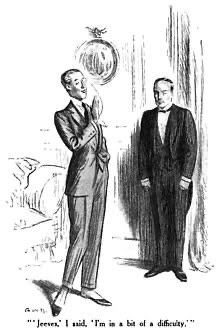
How about a servant, who is more respectfully called a valet, having a magic wand to solve all the problems, mainly small matters assuming monumental proportions? What about situations arising when the main protagonist is a lazy, laid back, idle member of English aristocracy, surrounded mainly by dim witted friends, termed blighted ? And the problems mainly pertain to the whims of aristocratic uncles and aunts who cannot be offended or ignored for these young lazybones depend on them for their monthly allowances and inheritance of their wealth! There are engagements and broken engagements, love triangles, game of one up man ship, lost and found, misunderstandings, false identities but never any rancour or malice. All is in good humour and ending is always happy for the protagonists and readers!
You must be wondering about the theme of this article. It’s on the current reading I am into – writings of PG Wodehouse ! I have read him before off and on. But during my recent Covid isolation, my attending physician advised me to avoid stress and read, watch and listen to only feel good stuff. So I have been watching nice videos of SPB on YouTube, listening to my favourite old Bollywood songs on Google play and reading P G Wodehouse.
PG Wodehouse’s novels, novellas, stories. his characters – Bertie Wooster, Jeeves, Psmith and uncles and aunts make up a very interesting light hearted read and the humour is subtle, but makes you burst into loud laughter at times. And the beauty of the language and use of quaint English words is to be read to be believed.
I have more than 5000 pages of PGW’s writings on my Kindle and as and when I come across the Master’s uniqueness, I will share the same with my readers.
Some light humour in these dark times is highly recommended.
Years ago, I read somewhere a short poem on our attitudes toward relationships. It read:
When my son-in-law
Takes tea in bed for my daughter
She’s so loving
And he’s so caring!
When my son
Takes tea in bed for my daughter-in-law
She’s so selfish
And he’s spoiling her.
This remains etched in my memory years after I read it because of its stark truth. And this came back to my mind the first thing when I received a forwarded post on my WhatsApp that talked about paradoxes as under:
(1) Moms want their daughters to control their husbands and sons to control their wives.
(2) Everything run by government is very bad except government jobs.
(3) We are always in hurry, but seldom on time.
(4) Holy places are very interesting – poor beg outside and rich inside.
I think there’s nothing paradoxical about the above things and it’s more to do with our attitudes. Every mother herself would have been all other three – a daughter, a daughter-in-law and a mother-in-law and she just needs to remain herself and not to change as per her role.
Government should not run businesses and govt jobs should have same benchmarks like private sector.
Punctuality is a virtue that is as important as honesty and truthfulness. If one wants, he or she can always be on time and I myself am a practising exponent of punctuality.
In front of God, we are all beggars and not everyone may be begging for money – people beg for issue, business, success and mental peace.
Some posts on social media exhort you to think and mull over it. This was one such post.
These days I get quite perplexed. There’s nothing that’s black and white – everything has shades of grey. My humble view is that things can either be good or not good. Or at least can be okay and not as good as originally conceived or expected; however, something which is well intended cannot simply be bad and undesirable.
If the farm bills are so good then why the press, electronic media and intelligentsia of the country are not coming together and cornering the leaders of agitating farmers and the fence sitter politicians. And if it so bad, why the nation is not coming together and forcing the Government to repeal these laws? Why there’s so much confusion, so much bitterness, so much bad blood and above all loss to the farmers for they should be spending this time sowing seeds in their farms, especially now that the God has gifted us with very beneficial winter rains and to the innocent public facing traffic jams?
My fear is that if this bitterness doesn’t end soon, there are anti social elements on the prowl sensing their chances to use this agitation to pursue their nefarious designs. We are hearing about separatists of different hue and colours surreptitiously entering the agitation to add fuel to the fire!
In a democracy, conflict of views is very common and any such instance requires deliberations between the conflicting parties. Also, in a democracy that’s live and breathing, peaceful agitations and demonstrations are bona fide tools to express resentment. But democracy also entails responsibility and sense of duty in addition to sense of right. Anything that weakens nation or national interest requires introspection and re-strategising. Flexibility and to bend a little to conquer are necessary ingredients of democracy. But we are seeing agitations of a different sort where agitating parties show rigidity, inflexibility and above all scant regard for inconvenience to common citizens. We noticed this during Shaheen Bagh sit-in and now seeing farmers doing the same. Worst, this can weaken the nation’s fight against coronavirus!
Government has bent to allay farmers apprehension. Now farmers should also bend a little and give Government an opportunity to demonstrate its intent. If the modified provisions are still falling short of farmers’ expectations, farmers can regroup to resume agitation.
For the sake of our country, let no fence sitter, manipulator, enemy of the country and any such dubious group take advantage of this agitation to weaken our great nation.
We love and respect our farmers and love our country too ! A weak farmer will weaken the country and that will not be tolerable to patriots of this country.
India is an agrarian country and economy because in spite of urbanisation, a large part of its populace is engaged in agricultural activities and a considerable part of its total GDP is contributed by agriculture. To feed a nation of more than 130 crore is no mean job and look at our markets that are flushed with not only food grains but also fruits, vegetables and other agricultural produce. And this is notwithstanding the fact that agriculture is still largely unorganised in the matters of finance and automation.
It’s to the credit of the farmers that a section of them have done well in their lives. They have mechanised farms and ability to hold on to their produce for the right price. They also have acquired general affluence in life in the form of good homes, vehicles and child/ relative abroad, mainly in Canada. But there’s also a section and mind you this section is in majority that lives in extreme penury, laden with debts and barely making two ends meet. It’s not for nothing that we come across so many farmers committing suicide.
For all the service rendered to the nation, sheer amount of hard work involved in farming and the uncertainties of nature that can spoil fully ripe crops, I have a bias in favour of farmers. I don’t advocate tax on farm income but support frequent waivers allowed by Government in the form of write off of farm loans. This profession simply cannot be equated with other professions and needs to be kept on a separate pedestal meriting preferential treatment.
Obviously, if I hold the above feelings, I cannot be supportive of any politics around their cause. Sharad Pawar might have advocated amendment to APMC acts as agricultural minister and he could be opposing new farm bills now. Congress might have earlier contemplated such bills and could have upped its antenna against the government now. It’s all about the role play. Parties do change their stand depending on whether they are in power or opposition and we should not make too much out of it. Also, labelling all those opposing government stand as traitors or part of tukde tukde gang is anathema to healthy democracy. After all Umar Khalid, Sharjil Imam, Kanhaiya Kumar etc aspire a career in politics and they will reach and support any movement that helps them further their ambitions. I also saw a reference to overseas Khalistani groups extending their support to this movement. That does not make farmers’ movement anti nationalistic.
Farm laws are good for farmers, at least in parts and are progressive. But in democracy no idea can be enforced – it has to be hard sold. A thing can be good only if it’s found good by the targeted audience. If farmers feel that farm bills are not good for them, there’s no fun pushing these bills down their throat. If government’s intentions are noble, it can do so much for all sections of society, not limited only to farmers, without fiddling with constitution or laws of the land!
Jai hind! Long live peasantry the annapuraks of this country!
My readers must be confused whether I have gone berserk? No, in fact all the above are iconic Tamil songs sung or composed by the only one – the legend S P Balasubrahmanyam ! As I grieved his untimely death due to Corona virus, I attempted to explore his work outside Bollywood and was amazed at his repertoire, more particularly in Tamil.
My search on YouTube took me to certain videos concerning the maestro’s 2019 tour of Singapore. Accompanied by ever dependable Chithra and another legend K J Yesudas, it’s a performance by SPB to be seen to be believed. The way he regales and enthrals his audience with his on stage mannerism and antics, but more precisely with his music, is to be seen to be believed. The concert I believe happened at an open ground near CODDISIA converted into a concert hall boasted of excellent setting, stage and acoustics that were the highlights. My search told me that SPB had acted and composed music for Tamil blockbuster SIGRAM, for which KJY sang this immortal song Agram ippo sigram achu composed by now immortal SPB. Towards the end of the song as SPB joins his vocals with KJY, it’s a surreal experience with one master, SPB, bowing to touch the feet of another master, his senior KJY!
SPB’s rendition of Ilya Nila made me ecstatic as it has the same tune as “Neele Neele Amber pe” sung by my favourite Kishore Kumar. Without going into the controversy of whether Tamil version was a copy of Hindi version or vice versa or whether one was reproduced after taking permission from another, rendition by SPB at Singapore concert is a must for all music lovers.
Let me clarify here! Unlike Bangla that I can speak and understand, I do not know even abc of Tamil and all the above songs are just musical journeys for me and not poetic, though my sense is that some of these songs could be poetic masterpieces. I also know that Tamil is not an easy language to understand or learn. But late icon SPB has inspired me now to dwell deeper into his work, especially in Tamil and more specifically that he co-created with another master Illaiyaraja ! My Tamil lessons will start soon but till then nothing can stop me from enjoying these pearls of melody!










 Arvind Arya blog