It’s my habit to read the thoughts inscribed on the boards outside churches and as the famous Mahim Church is enroute my office, I seldom miss a thought outside this church. However, today’s thought on the board, “Advent creates people. New people. “ sort of confused me forcing me to look into the meaning and rationale behind this thought. To my surprise, the thought had a lot of tradition behind it.
The Advent season is a four week period before Christmas that celebrates the anticipation and coming of Jesus Christ. Not only is the Christian meaning for preparation and celebration of the coming of Jesus Christ, his birth at Christmas, but also to celebrate the new life when someone accepts Jesus Christ as their Savior, and lastly, the anticipation of Jesus returning again. Hence the thought – people – new people.
The season of Advent begins from the fourth Sunday before Christmas through Christmas Eve. The four Sundays of Advent each have a specific theme or focus. The purpose of each theme is to spend time reflecting on the true meaning of the season – the life of Jesus Christ. As I understand the theme for each of these 4 weeks of Advent are- The Prophets’ Candle, symbolizing hope; the Bethlehem Candle, symbolizing faith; the Shepherds’ Candle, symbolizing joy; the Angel’s Candle, symbolizing peace. Hope–Peace–Joy–Love. Faithfulness–Hope–Joy–Love.
Thanks to this thought, I could know these additional details about Christian faith in this season of joy and hope – Christmas.
Like there are winners in sports – gold, silver and bronze medallists, there are winners in the life’s race too! And like there are those finishing at number four downwards, who are called “ Also ran”, in sports, there is this category in the real life too! Yours truly, the author of this blog, considers himself to be one such “also ran”.
However, a slightly more deep and scientific analysis reveals that this is more to do with genealogical and birth related issues rather than an issue of an individual’s ability and capability! Let me explain how. The first born in any family is generally much adored and an apple of everyone’s eyes. And if the first born is also a first born in the extended family, such a baby is spoilt for choices. Naturally, such babies get groomed so well that they turn out to be winners!
Let me explain my familial position in the above context! My mother has six other siblings, she being the eldest in the family and naturally an apple of my grandparents’ eyes. When my elder brother was born, he was first born not only for my parents but was also the first grandchild. The adoration that he received made him smug, confident and a natural winner! Each of my mother’s siblings has 2 kids, making the total count to be 14! After the birth of my brother, children just kept on getting born, with the elder of the two in a family getting slightly more importance than the second! I am number two in hierarchy on the maternal slide, which is equivalent of also ran!
My father had four siblings and he himself was number three! He almost treated his eldest brother like his father as my grandfather expired rather early and my eldest uncle carried the family along. In this tree on the paternal side, my position is even more pathetic! While on the maternal side, I am at least number two ( though it’s like coming second in a race ran by two participants), on my fathers side, I am second from the bottom in a brood comprising 14 siblings! My elder cousins still treat me like a baby, just short of cuddling me, and a baby can be adored, cuddled and kissed, but never placed on the winning podium!
I am also ran because of fault of my parents and grandparents and not because I had or have ordinary abilities! This way i feel good and almost like a winner having one a gold medal!
There’s an advertisement being aired these days in which a person deeply engrossed in eating chocolate is unaware of everything happening around and his inaction is proving to be benevolent to others. These beneficiaries, in fact, thank the chocolate eater for not doing anything.
If not doing anything is so cool that it has been used as an underlying idea for effective advertising, I am not sure as to why people around me are getting so much worked up about my impending retirement. The first question that’s posed to me is, “ What are you going to do after retirement? “ and I always thought that retirement meant that one had to to nothing !
And unlike the chocolate eater in the ad, I am not a born idler! In fact, I am going to retire after having slogged very hard for almost 4 decades! Moreover, I am not completely bereft of any interest, passion or talent ! I am an avid reader, love to travel and already have a blogging site that has over 700 blogs! I want to read, write and travel and these three combined should not add up to “ Nothing to do.”
As a tot I played with toys
And as a child I studied with boys!
In college I had my companion in books
And ensured that life never got off the hook!
As a professional I worked diligently
And planned my life most intelligently!
Deferred all my passions and interest to later life
Along with plan to spend quality time with my wife
Now that the time for leisure and joy is in the offing
People are agog with anticipation as to what next I am doing
When I tell them that I intend to do nothing
They sneer at me as if I am good for nothing!
On a lighter note, I want to assure my readers that once free from my official obligations , I am most likely not going to be in “ Nothing to do” category and they should not fear bombardment of blogs, messages and posts from me. People around me will ensure that I don’t become an idler. In fact, I am shortly planning to start looking for new jobs! 😃
One of the favourite topics of story tellers, bloggers and anecdote writers is nostalgia- especially about “good old days” and the cities and places where they would have spent a large part of their childhood. This is normal as most of us have indeed very sweet memories of our childhood and the place where most of it was spent. I have seen people talking about the good old days in almost all the cities- Kolkata, Delhi, Chennai , Lahore, Karachi ( as I can read Urdu, I sometimes follow Pakistani newspapers, which are also replete with nostalgia of the past) and especially Mumbai. Someone like me, who made Mumbai his hometown much later in 2001 in my 40s, also frequently feels nostalgic about the Mumbai of yore – the charm of Fort area ( in mess currently due to ongoing Metro work), heritage buildings with gothic architecture ( many of these seem to be under perpetual repair and renovation), hustle and bustle at Nariman Point ( no longer a financial hub- BKC emerging as a new hub), absolutely scenic Marine Drive ( again out of shape thanks to coastal road work), closure of several iconic joints – Parsi-Iranian restaurants, cafes, bakeries, Kwality, Purohit thali, Cafe Samovar etc. and decline in traffic discipline.
I also have similar feeling about Delhi, my birthplace, where I grew up and spent my entire childhood and adolescence – a quaint, green, relaxed place of 60s and 70s that has since metamorphosed into a megapolis with all the usual problems.
However, here I would like to present a slightly different perspective to this much cherished but sometimes a bit hyped emotion. Delhi of yore had lots of problems. It’s local transport was unreliable and erratic till 1974 when Greenline service with Central Secretariat as hub was introduced. Till 80s, the power supply used to be marred by cuts and load shedding and people used to talk about good position in Mumbai. There were only two bridges linking rest of Delhi to Trans Yamuna area and sometimes the traffic jam on the old British era bridge was nightmarish. Autos and taxis were either not available or had tampered meters, charging unreasonable fares.
In contrast, Delhi of today boasts of world class metro network, elaborate flyovers, e rickshaws that are affordable and pollution free, fleet of AC buses all running on CNG, Airport that handles more flights per day than any other airport in the country, a consistent power supply and host of eating and outing options.
To change the perspective again, may be we feel nostalgic about the simplicity, less materialism, leisureliness, more time for relationships and sheer delight in the things that would today look a mere passé!
Nothing could be more appropriate than the above lines from Gurbanee on this Gurupurub to celebrate the birth of Guru Nanak Devji. First the Kartarpur corridor was reopened to facilitate free movement of devotees without Visa to Gurudwara Darbar Sahib, where Guru Nanak is reported to have breathed his last. This makes kartarpur the second holiest site after Nankana Sahib, the birth place of Guru Nanak, also in Pakistan. . And now the Government has taken a major step in ending the long standing conflict with farmers by repealing farm laws.
Let farmers go back to their fields and general peace may prevail over mankind. This is my wish for the entire humanity this Gurupurub.
Just received a beautiful post on WhatsApp in which the protagonist, a senior citizen colourfully dressed, objects to be a called an old man and insists that he be addressed as a senior citizen. An old man represents old age while a senior citizen represents seniority. He then goes on to explain the essential difference between the two. He says that while an old person laments about the past, a senior citizen adapts to new way of life. An old person looks for and seeks support while a senior citizen provides support and is a source of inspiration. Old man awaits the end while a senior citizen awaits a new morning with enthusiasm.
The protagonist further goes on to advise that age is just a number that should not in any way come in the way of the quality of life. And while most of this post is about mindset and attitude, it propagates the need to dress colourfully, which is symbolic of retaining colour in one’s life.
History as per definition in Cambridge dictionary is the study of or a record of past events. However, any attempts to distort history through post facto reinterpretation or ascribing motives based on subsequent developments is fraught with dangerous consequences. If it’s not a faithful record of events, it’s not quite history but some other subject.
The reason for this rather cryptic start to this blog is a series of posts and articles that are doing rounds in social media on India’s first Prime Minister, Pt Jawaharlal Nehru, whose birthday we are celebrating today as children’s day. These posts talk about his errors of judgment and wrong decisions in the context of Kashmir, Pakistan and China, his westernised lifestyle, his alleged weakness for good things in life, his disagreements with Sardar Patel and his purportedly Muslim lineage, Not that there are no contrarian articles on his socialism, his moderation, developmental agenda to make India self sufficiently and his secularism.
I think the success of any democracy lies in the freedom of speech and expression, but let’s use history only to make our present and future better so that mistakes of the past do not come back to haunt the nation again. Let’s leave Gandhi, Nehru, Patel, Azad and even Indira, Rajiv and Atal Bihari Vajpayee in the annals of the history for these people cannot defend whatever we write or say about them now!
Let’s simply celebrate 14th November as a happy event called children’s day irrespective of whether we agree or not with what these people did or thought!
When Lord Rama returned to Ayodhya after killing Ravana, people of Ayodhya lit diyas to welcome their favourite king and this purportedly is the origin of Festival of Lights, Diwali.
Over the years the festival got transformed from decorating houses to bursting fire crackers to starting new venture to starting new account ledgers ( bahi khatas) to eating sweets to exchanging gifts to gambling et al. But the real essence of Diwali is reiteration of the feeling of happiness, hope, optimism, positivity and above all generosity and empathy towards those not as well as us!
This Diwali let’s hope the darkness of pandemic is eliminated and that a stronger India and better future for all bring joy, happiness and prosperity to all !
Wishing all my friends and acquaintances a very happy , healthy and prosperous Diwali!
We are regular visitors to Johannesburg as our daughter’s family resides there, though thanks to the Covid pandemic, this time we visited South Africa almost after 3 years and meeting our daughter’s family after 2 years, her last visit being during Christmas just before the Pandemic set in.
Now that her children are of slightly more manageable age, this time our trip and stay was not restricted to Johannesburg; in fact, she and her husband had arranged a weeklong road trip to three of the most cherished destinations in that country.
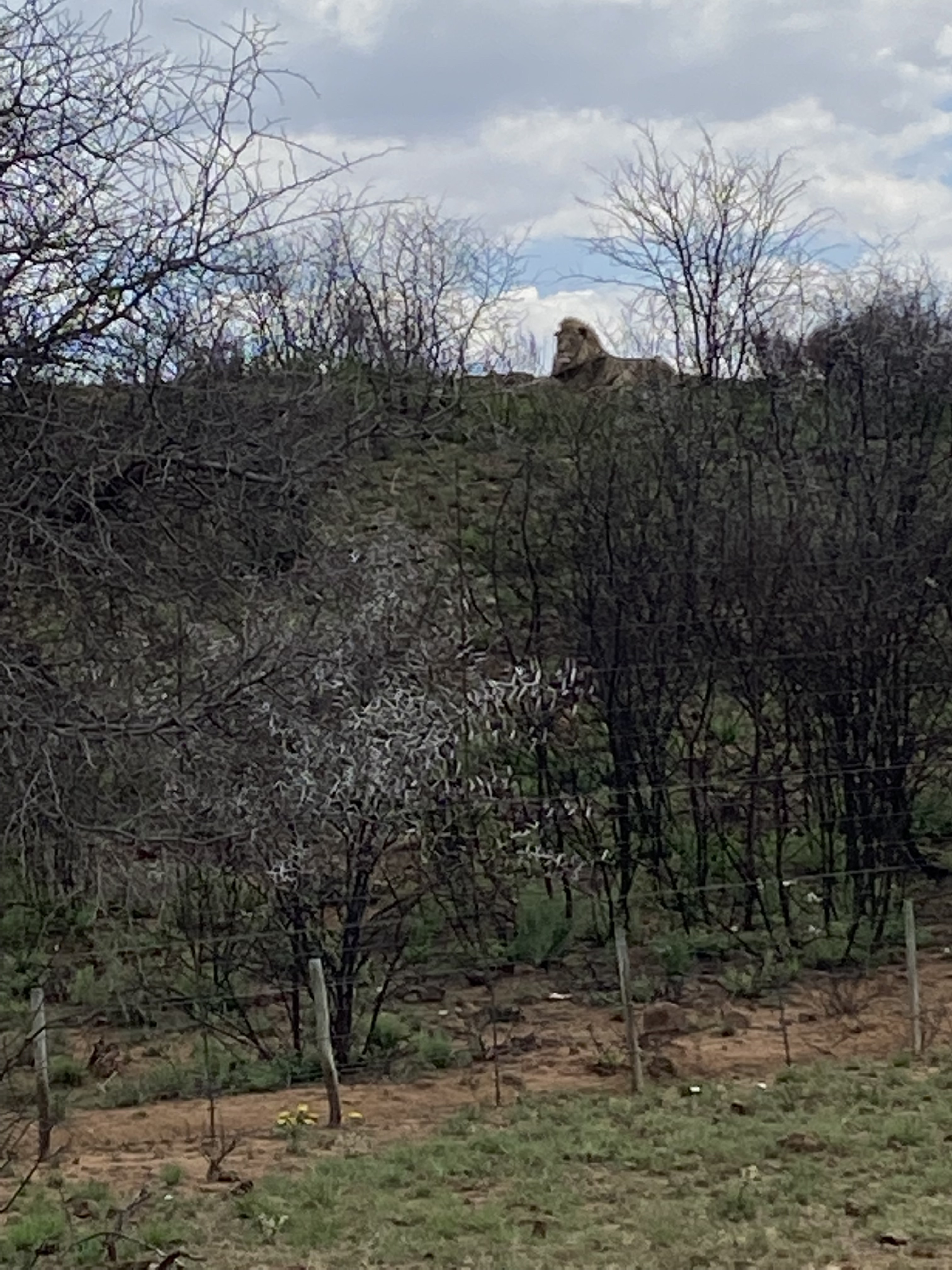
We started in two vehicles- being driven by my daughter and her husband, loaded with all the provisions required by a large family for one week. No stay was in a Hotel and therefore, all the cooking was to be done ourselves for which all the provisions were required, the proposed destinations being remote in the finest sense. Our first destination was Bush Camp, some 400 odd kilometer from Johannesburg, closer to the South Africa’s major city of Bloemfontein. The camp set up by a wildlife aficionado is spread across acres and acres of wild bush forests that are home to several wild beasts – more prominently Lion, Leopard, Giraffe, Zebra and antlers. The cabins built in the midst of forest, of course protected by fences, had just about bare essentials. The meal cooked on wooden logs that also served the purpose of bonfire under starlit open sky with chilling cold was an unforgettable experience. Two nights at this location especially meant a whole lot to the young kids, who had a whale of a time in sighting animals at their wildest best. Of course, a visit to Bloemfontein next day, which was around 70 kilometres from the camp site exposed us to a well planned, neat and clean city with a colonial overhang, with large white population.
A lion resting majestically atop a hill in the bush campCheetah cage – a favourite place of my grandsons. Once grown, Cheetahs are then released into wilderness.
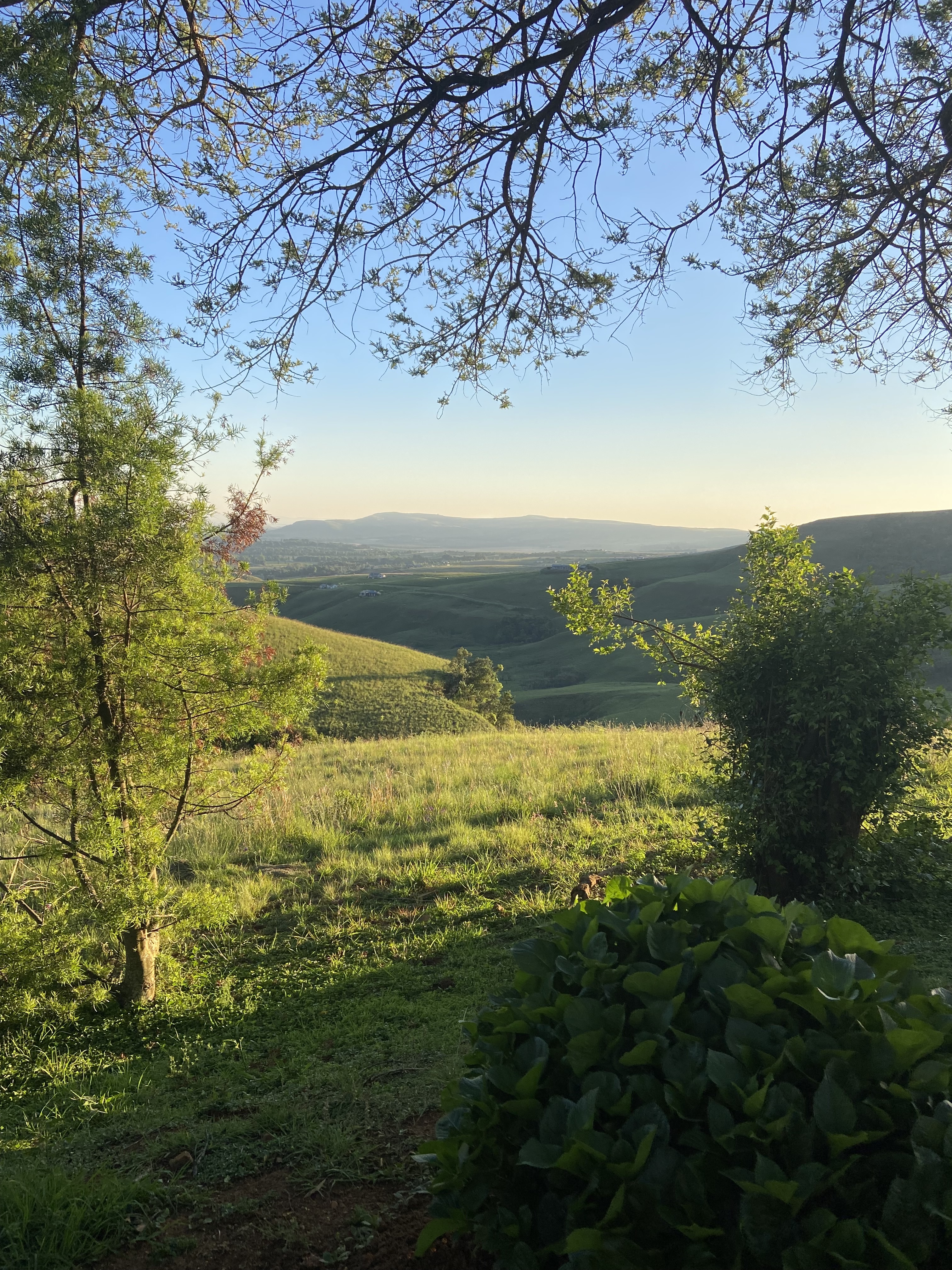
After two nights of adventure, it was time to leave for the hills of Drakensberg. This journey too was more than 400 kilometres and the stopover at foothills provided a scenic views of the mountains that had just seen snow having melted away paving way for lush greenery. Colonial type of cottages, golf course, wineries, plantations, all lent an aura of awe to this place. Just behind the mountains lies a small independent country Lesotho. Two days at Drakensberg included freewheeling visit on mountain trails and mandatory wine tasting at a few wineries. The place is like heaven on the earth, with the countryside having the same quaintness and beauty that’s comparable to Switzerland.
A bird’s eye view of Drakensberg Sun is about to set behind the mountains- Drakensberg
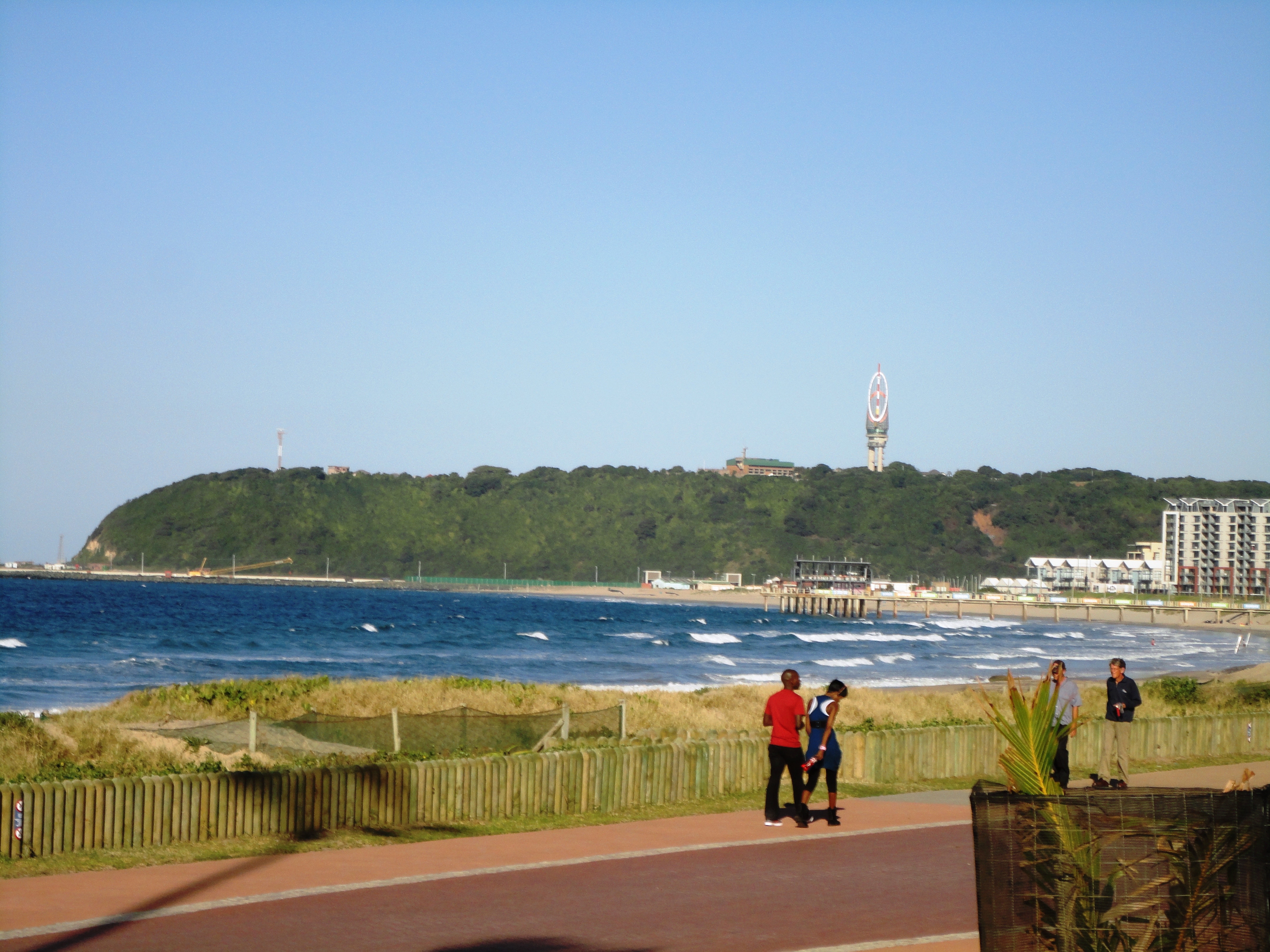
Other 300 kilometers drive took us to the port city of Durban. Actually, I thought Durban was like any other old port city – congested, busy, business like. But I was proven totally wrong. It actually turned out to be as beautiful as the famous Cape Town, if not more. It’s terrain is hilly and from the top of the hills, the sight of clear blue waters of Indian Ocean is panoramic to say the least. And while I was told that climate of Durban was akin to my home city Mumbai, also a port city, Durban during our brief stay was quite chilly, windy and overcast. The city has a large Indian diaspora and Chatsworth Centre in Durban looked like any other Indian mall with restaurants and shops having Indian lineage and connection. Had wonderful food at an Indian restaurant and beautiful beaches, city centre and casinos made Durban a complete tourist package.
Sunrise as captured from our apartment atop a hill on the beautiful Bluff beach of Durban
Drive back to Johannesburg from Durban, a good 600 kilometers stretch, was another pleasure and it was good to be back after a memorable weeklong tour of this beautiful country of South Africa comprising nature, wildlife, sea, beaches, mountains and well appointed cities of Bloemfontein and Durban! No amount of thanks to my daughter and her loving husband for taking all the pains, including long drives, would be sufficient. And of course, the company of our cute grandsons to our entourage only made the journey more memories!
There are two type of people – conversation makers and conversation killers. Conversation makers feed conversation by engrossing themselves fully into conversation. On the contrary, conversation killers are in a hurry to end a conversation.
An essential difference between a conversation maker and conversation killer is that a conversation maker expresses keen interest in the topic on which conversation is happening. He makes conversation interesting by fuelling it with the facts that he has about the topic and raising questions on the things that are alien or not known. A conversation killer shows no interest in the topic and either tries to change the topic or presents a blank face to the starter of the conversation.
A versatile converser is one who can carry on conversation on large number of topics, an ability that arises from one’s exposure to diversified subjects mainly due to the habit of reading. He or she also has ability to shift levels and gears depending on the person on the other side. One should be able to carry on a conversation with the same aplomb with a 6 years old as with an eighty years old, He or she is generally equally at ease with a sportsman, a litterateur or a scholar.
This as much applies to oratory too. Oration is like a conversation with audience and unless there’s a connect, which is established mainly by evoking interest in them, a speech is also like a one way communication likely to be killed without achieving any purpose.
The thought for this blog once again is attributable to ever so relevant perspective of the great Mahatria, whose gems are being shared with me daily by one of his ardent followers. These are motivational, inspiring and capable of changing our approach towards life. His yesterday’s Pearl that inspired the above blog read:
“People find you interesting only when you show interest in what they are interested in.”








 Arvind Arya blog